
The Art and Influence of Winslow Homer
Nov 18th 2025
Winslow Homer stands as one of America’s most iconic painters, a self-taught artist whose works captured the raw power of nature and the quiet dignity of human life with an authenticity few have matched. From his early illustrations of Civil War life to his later seascapes painted in the isolation of Maine, Homer’s art embodies the spirit of the American experience: its rugged independence, its confrontation with nature, and its deep introspection.
Here we will review Homer’s influence in the American art scene as well as why Winslow Homer prints and other items make great additions to any space in need of a bit of classic Americana charm.
Early Life and Artistic Foundations
Born in Boston in 1836, Winslow Homer began his career not as a painter but as a commercial illustrator. His mother, an amateur watercolorist, nurtured his early creativity, and by his late teens he had apprenticed with a lithographer, learning the fundamentals of composition and visual storytelling. These formative years gave him a strong sense of design and the ability to capture decisive moments, skills that would later define his paintings.
Homer’s early success came through his work for Harper’s Weekly, where he illustrated scenes of everyday American life, from bustling city streets to soldiers on the battlefield.
His Civil War sketches were particularly poignant; they avoided sensationalism and instead conveyed the humanity of soldiers, the exhaustion of conflict, and the quiet resolve of those caught in its midst.
The Transition to Painting
After the war, Homer turned his attention from illustration to fine art. His postwar works, such as Veteran in a New Field (1865), marked a clear shift toward symbolic realism. In this painting, a soldier has returned from war to the peaceful act of harvesting wheat—a subtle yet profound commentary on renewal and the cyclical nature of life.
Homer’s early paintings often depicted rural life and leisure, reflecting the ideals of Reconstruction-era America. Works such as Snap the Whip (1872) and Breezing Up (A Fair Wind) (1873–76) showcased children at play and men at sea—simple subjects elevated by his understanding of light, color, and gesture. His brushwork, though tight and controlled in these years, began to loosen as he experimented with how to express motion, atmosphere, and mood.
Maturity and the Sea
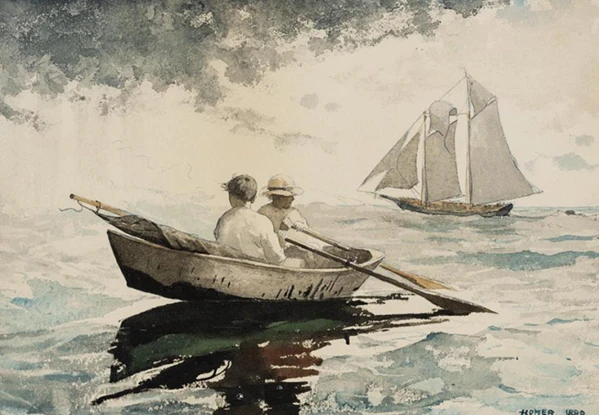
Homer’s move to Prouts Neck, Maine, in 1883 marked a turning point in his career and life. There, surrounded by the Atlantic’s relentless power, he found both solitude and inspiration. His seascapes from this period: The Fog Warning (1885), Eight Bells (1886), and The Gulf Stream (1899), reveal his mature vision: humanity’s struggle against nature’s vastness.
In these works, Homer’s color palette darkened, his compositions grew bolder, and his themes deepened. The sea, in Homer’s hands, became a metaphor for existence itself—unforgiving, majestic, and indifferent. His fishermen, sailors, and rowers are not romanticized heroes but stoic figures pitted against the elements, embodiments of endurance and courage.
Homer’s technique evolved dramatically in these years. He worked with both oils and watercolors, mastering the latter to a level few had achieved before him.
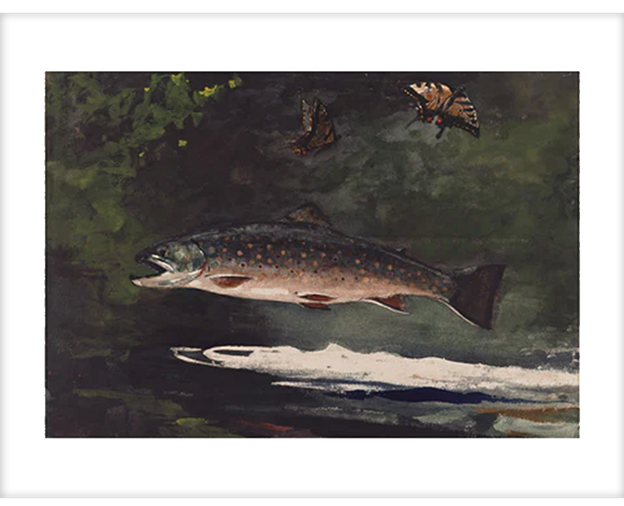
His watercolor studies of rocky coastlines, tropical sunlight, and stormy seas demonstrated a breathtaking fluidity of touch. The transparency and immediacy of watercolor suited his temperament—spontaneous, direct, and rooted in observation. It's this skill that is highlighted in our exhibition, Of Light and Air: Winslow Homer in Watercolor, which runs from November 2nd 2025 to January 19, 2026.
Themes of Solitude and Resilience
A thread of solitude runs through Homer’s work, especially in his later years. His figures are often alone: a man rowing through rough seas, a woman gazing from a cliff, a hunter in a snowy wilderness. These scenes are less about loneliness than about the individual’s relationship with the world around them.
Homer had an almost transcendental understanding of nature. He depicted it not as a backdrop but as an active force—sometimes nurturing, often perilous, always commanding respect. His art reflects the American belief in self-reliance and perseverance, yet it also carries a sense of humility before nature’s power.
In works like The Fox Hunt (1893), the landscape becomes an arena of survival. The painting’s stark winter setting and sharp contrasts embody the tension between life and death, predator and prey. Homer’s brushwork here is visceral, almost sculptural, emphasizing movement and immediacy.
Watercolor Mastery and the Caribbean Period
Homer’s travels to the Bahamas, Florida, and Cuba in the 1880s and 1890s expanded his palette and subject matter. The bright tropical light challenged him to capture new tonalities and atmospheres. In works such as The Water Fan and Searchlight, Harbor Entrance, Santiago de Cuba, his watercolors became studies of radiance and reflection.
He was a pioneer in elevating watercolor to the level of serious art in America. What had been regarded largely as a medium for sketches or amateurs became, through Homer’s hands, a vehicle for profound expression. His control of transparency, texture, and layering created works that seemed alive with air and light.
Influence and Legacy
Winslow Homer’s influence on American art is vast. He helped establish a distinctly American realism, one rooted not in European traditions but in the land, sea, and people of the United States.
His vision shaped generations of artists, from the American Impressionists to the early 20th-century realists like Edward Hopper, who shared his fascination with solitude and the geometry of light.
Moreover, Homer’s treatment of nature laid groundwork for modern environmental aesthetics. His works remind viewers of the sublime, an emotional response to nature’s power that combines awe and respect. In this way, his paintings remain profoundly relevant in an era increasingly aware of the fragility of the natural world.
Museums and historians continue to study Homer not just as a painter of beautiful scenes, but as a philosopher in pigment, an artist who asked timeless questions about man’s place in the universe. His technical mastery, coupled with his moral depth, ensured that his art would endure beyond trends or movements.
Winslow Homer Prints, Gifts, and More
Winslow Homer’s art is both a reflection and a revelation of the human condition. His subjects—fishermen, farmers, children, and sailors—are at once ordinary and heroic, caught between survival and serenity. Through them, he captured the essence of America’s struggle and grace.
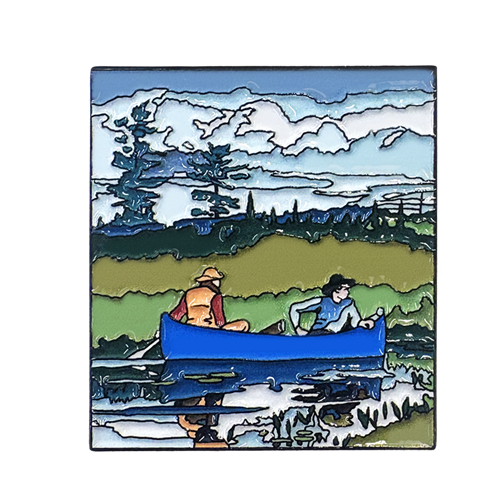
Whether in the crashing waves of Maine or the golden glow of a Caribbean afternoon, Homer’s paintings continue to speak across time. Many of his iconic works are captured in our collection of Winslow Homer prints and other gifts that are available here in our Museum store. Explore today and bring home some of the magic and American spirit infused in Homer’s works.